
What is Temporal Knowledge Graph Reasoning?
Understanding How AI Systems Learn and Adapt to a World That Changes

TL;DR
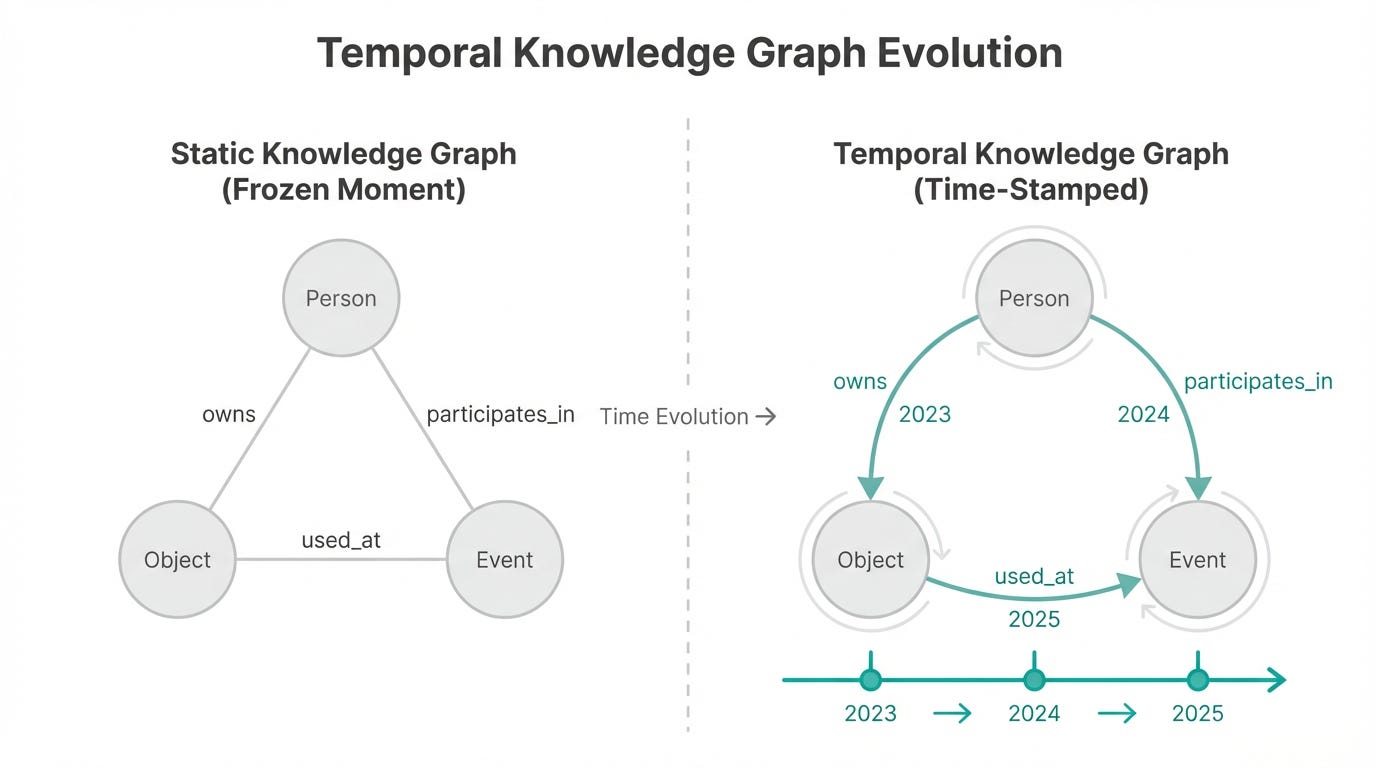
Temporal knowledge graphs extend traditional knowledge representations by adding time as a first-class dimension, letting AI systems track when relationships and facts change
They enable AI to understand cause-and-effect sequences, predict future states based on past patterns, and reason about incomplete or evolving information
This matters because the real world isn’t static: people move, relationships form and dissolve, objects change properties, and events unfold in sequences that demand temporal reasoning
The Problem with Timeless Knowledge
Think about what you know about your world right now. Your friend lives in a specific city. Your company has certain employees. A restaurant serves specific menu items. These facts feel stable.
But they’re not. Your friend might move next month. The company will hire new people. The restaurant will update their menu. The challenge for AI systems is that traditional knowledge representations (including most knowledge graphs used today) treat facts as if they’re eternal.
A traditional knowledge graph captures entities (people, places, objects, concepts) and the relationships between them. Alice works at Company X. City A is in Country B. Node A connects to Node B. These representations have powered much of modern AI, from recommendation systems to question-answering engines.
The problem appears when you ask the graph a slightly more complex question: “When did Alice start working at Company X?” or “What was the restaurant’s menu last month?” or “Did these two events happen in sequence, or did one cause the other?” Most traditional graphs can’t answer these questions, because they don’t store temporal information at all.
Adding Time as a Fundamental Dimension
A temporal knowledge graph (TKG) does something deceptively simple: it adds time to every fact.
Instead of just “Alice works at Company X,” a TKG stores “Alice works at Company X, from March 2024 to December 2025” or “Alice worked at Company X at timestamp T1, then moved to Company Y at timestamp T2.” Every edge, every relationship, every fact gets a temporal anchor.
This isn’t just annotation. Adding time as a first-class dimension fundamentally changes what the graph can represent and reason about. Suddenly, causality becomes expressible. Sequences matter. You can ask not just “what is related to what,” but “what came first, and what happened next?”
Consider an egocentric scenario, like the kind EgoGraph captures from video: a person moves through an environment, picking up objects, interacting with others, moving between rooms. A static graph might record “object X is in room Y” or “person A is interacting with person B.” But the temporal version records the trajectory: person A entered room Y at 2:15 PM, picked up object X at 2:17 PM, then moved to room Z at 2:22 PM where they encountered person B. This temporal structure is essential for understanding what actually happened.
Why This Matters for Modern AI
Here’s where temporal knowledge graphs become essential rather than optional: today’s AI systems increasingly need to maintain and update world models that change.
An AI assistant helping you manage your schedule doesn’t just need to know you have a meeting at 3 PM. It needs to know you had a meeting at 3 PM yesterday (did you attend?), you have one scheduled for tomorrow, and based on your meeting patterns over the past month, you’re likely to be scheduled for similar meetings next week. The temporal dimension enables prediction and pattern recognition.
A system reasoning about agent memory, specifically what an AI agent remembers about its interactions with you over time, requires temporal structure. Temporal knowledge graph architectures like those used in Graphiti and Zep don’t just store interactions. They timestamp them, sequence them, and make temporal relationships explicit so the agent can answer “what’s changed since we last talked?” or “what patterns do I notice about how this person behaves?”
This is the critical insight: static graphs describe a world frozen in time. Temporal graphs describe a world in flux. And the real world is always in flux.
Reasoning Under Uncertainty and Change
One common misconception is that temporal knowledge graphs are primarily useful for historical data, answering what happened when. They’re equally valuable for reasoning about incomplete or uncertain current states.
Suppose you’re tracking events in a complex system: supply chains, social networks, or organizational structures. At any given moment, the current state is only partially observable. What you have are snapshots and recent changes. A temporal graph lets you reason backward: if certain facts changed, what else must have changed? If certain facts are typically causally linked, and I observe one, what should I expect to see next?
The TKG-Thinker framework demonstrates this in action, using reinforcement learning to train agents that reason over dynamic temporal knowledge graphs. Rather than retrieving pre-computed facts, the system learns policies for how to explore and reason about temporal relationships as new information arrives. It doesn’t just answer “what is true?” but “what could be true, and why?”
This approach flips the script on a fundamental assumption in knowledge representation: that the goal is to encode all known facts upfront. Instead, TKG reasoning treats the graph as something an agent explores, learns from, and updates as it encounters the world.
From Static Facts to Dynamic Models
Here’s a concrete example that makes the difference tangible. Imagine an AI system needs to recommend who you should talk to about a problem at work.
A static knowledge graph might store: “Alice is in the marketing department. Bob is in product. Carol is in engineering.” If you ask “who should I talk to about our marketing-product alignment issue?”, the system might suggest Alice or Bob based on keyword matching.
A temporal knowledge graph could store: “Alice was in marketing from Jan 2023 to Sep 2024. Bob joined product in June 2024 and was previously in marketing from April 2022 to June 2024. Carol has been in engineering the whole time. Alice had a meeting with Bob on March 10, 2026. Bob and Carol have had no recorded interactions.”
Now the system could answer: “Bob might be your best contact because he has experience in both departments and recently connected with the product team. But Carol has the deepest technical context, even though she hasn’t directly worked with Bob before.”
The temporal information enables richer reasoning. It allows the system to understand career trajectories, timing of transitions, patterns of collaboration, and who has relevant recent experience.
The Challenge of Incomplete and Messy Temporal Data
Adding time also adds complexity. Real-world temporal data is often incomplete, noisy, and uncertain.
Events don’t always have precise timestamps. Relationships might have fuzzy boundaries: when exactly did a friendship end? Is someone still a “friend” if you haven’t talked in a year? Temporal knowledge graphs have to represent not just exact times but temporal uncertainty and persistence.
There’s also the problem of what AI researchers and philosophers call the “frame problem”: what persists across time? If Alice worked at Company X in 2023 and Company X is still in New York, we can infer Alice was in New York in 2023. But if we only know Alice was in New York in 2023, we can’t infer anything about where she is now. Temporal graphs must carefully distinguish between facts that persist, facts that change, and facts that remain unknown.
Some systems handle this through explicit validity windows: each fact has a start time, an optional end time, and a confidence level. Others use probabilistic approaches where the graph itself encodes uncertainty about when facts change.
This complexity is why reasoning over temporal knowledge graphs is harder than reasoning over static ones. But it’s also why the capability is so valuable.
Temporal Reasoning as a Core Capability
As AI systems move from answering factual questions to managing evolving contexts (user histories, changing environments, unfolding events), temporal reasoning becomes non-negotiable.
The implications extend to areas you might not expect. Personal AI assistants need temporal awareness to understand that your preferences evolve. A recommendation system needs to know that you loved a particular restaurant last year but haven’t been back since. A health tracking agent needs to understand the temporal progression of symptoms, not just their presence at a single moment.
Even the concept of trust between a human and an AI agent is temporal. The system earns trust by demonstrating that it remembers your past correctly, understands how your situation has changed, and can reason about what that change means for your future decisions.
The systems that will be most useful won’t just know facts. They’ll understand change. They’ll track causality and sequences. They’ll make predictions based on how similar patterns unfolded in the past. They’ll maintain consistent models of worlds that don’t stop moving.
Temporal knowledge graphs are the representation that makes this possible. They’re not a niche feature. They’re foundational infrastructure for any AI system that needs to understand and adapt to a world in motion.
References and Further Reading
TKG-Thinker: Agentic Reinforcement Learning for Temporal Knowledge Graph Reasoning - arXiv preprint, February 2026
EgoGraph: Temporal Knowledge Graphs for Egocentric Video Understanding - arXiv preprint, February 2026
Graphiti: Temporal Knowledge Graphs for AI Agent Memory - Framework documentation
Zep: Open Source Platform for Agent Memory - Temporal knowledge management system
Knowledge Graphs - Amit Sheth, MIT Press
Temporal Knowledge Graph Completion Using a Recurrent Event Knowledge Graph Embedding Framework - Academic reference on TKGE methods
Reasoning over Temporal Knowledge Graphs - Survey of temporal reasoning approaches