
What is Closed-Loop Agent Execution?
The Safety Mechanism That Checks AI's Work

When humans perform complex tasks, we naturally verify each step before moving forward. After sending an important email, you check your sent folder to confirm it went through. After booking a flight, you review the confirmation details. After transferring money, you verify the transaction completed.
This continuous verification—completing an action, checking the result, then deciding the next step—is so intuitive that we barely notice doing it. But for AI agents, it’s a relatively new capability called closed-loop execution.
And it matters enormously. Without it, AI agents can fail catastrophically while confidently proceeding as if everything worked perfectly.
The Open-Loop Problem
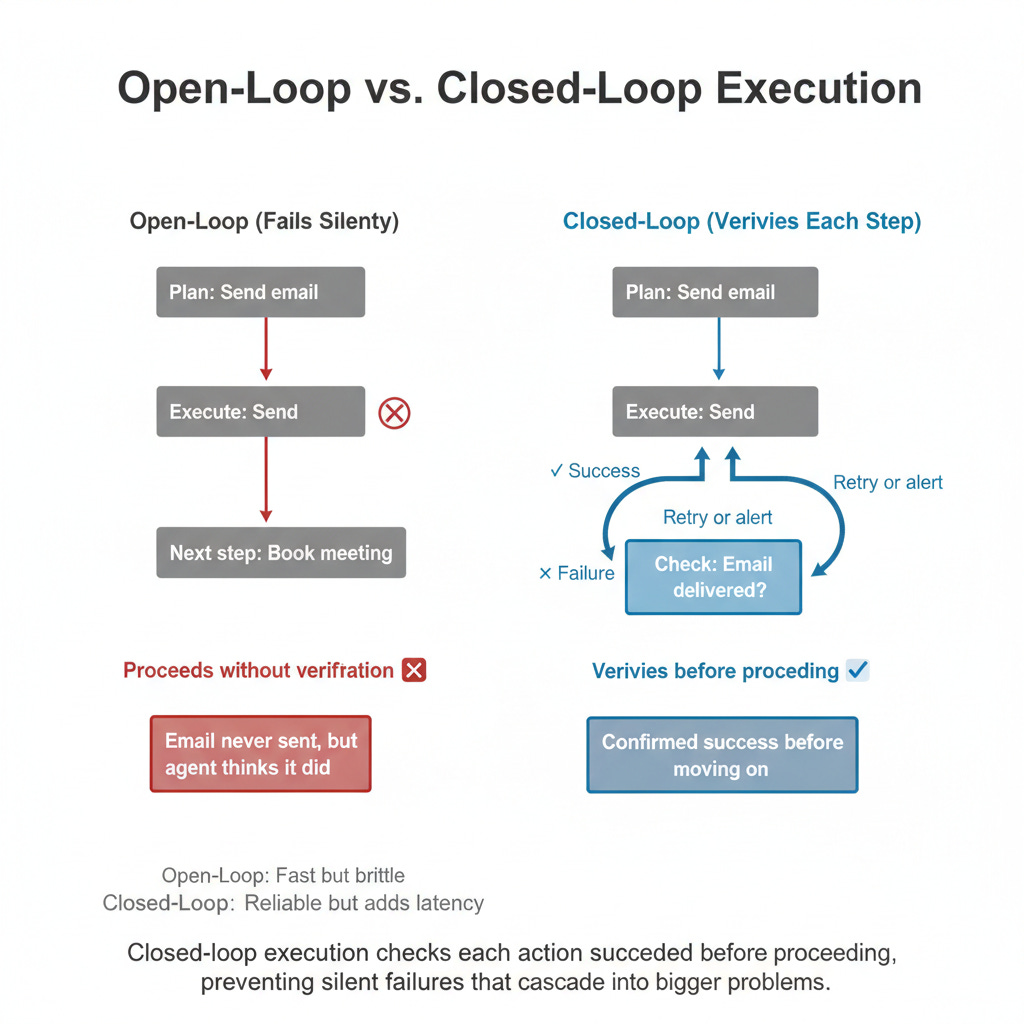
Traditional AI agents operate in open-loop mode. They generate a plan—a sequence of actions to achieve a goal—and execute it without checking whether each action succeeded.
Think of it like following a recipe blindly. Add flour. Add eggs. Mix. Bake. You don’t check whether the flour actually made it into the bowl, whether the eggs were beaten properly, or whether the mixture is the right consistency. You just follow the steps and hope it works.
For simple tasks in predictable environments, open-loop execution often succeeds. But in real-world scenarios where things go wrong, open-loop agents compound failures.
Imagine an AI agent tasked with booking a meeting. The plan looks like this:
Check attendees’ calendars
Find a common available time
Send calendar invitations
Confirm the meeting room is booked
In open-loop execution, the agent sends calendar invitations without verifying they were actually delivered. If step 3 fails—maybe due to a network error, or one attendee’s email address is incorrect—the agent doesn’t notice. It proceeds to step 4, thinking everything is fine.
The meeting never gets scheduled. Nobody knows. The agent reports success.
This failure mode is more common than you might think. Real-world environments are messy. APIs timeout. Network connections drop. External systems reject requests for unexpected reasons. Services rate-limit unexpectedly.
Open-loop agents can’t handle these contingencies. They assume success and move forward, often creating cascading failures that are hard to diagnose later.
How Closed-Loop Execution Works
Closed-loop execution adds verification after every action. The agent performs an action, observes the outcome, verifies success, and only then proceeds to the next step.
The meeting-booking agent in closed-loop mode would:
Check attendees’ calendars
Find a common available time
Send calendar invitations → Verify invitations were received
Confirm meeting room is booked → Verify room confirmation
After sending invitations, the agent checks: did the invitations actually arrive in attendees’ inboxes? If not, what went wrong? Can the error be fixed?
This verification step happens in the loop—hence “closed-loop.” The agent’s actions feed back into its decision-making, creating a continuous cycle of act-observe-verify-decide.
The verification isn’t always straightforward. For some actions, success is obvious: either the email sent or it didn’t. For others, verification requires interpretation. Did the document upload successfully? Check the file appears in the destination folder. Did the calculation execute correctly? Validate the output makes sense.
The agent needs verification logic for each action type. This requires more sophisticated reasoning than simple execution.
The Technical Challenge: Observation Spaces
For closed-loop execution to work, the agent needs access to observations that verify action outcomes.
In simulated environments or APIs with clear responses, this is manageable. Make an API call, check the HTTP status code and response body. Success or failure is unambiguous.
In physical or user-interface environments, observation becomes much harder.
If a robot manipulates an object, how does it verify success? Vision systems provide feedback, but interpreting visual information to confirm “the object moved to the target location” requires perceptual understanding. Lighting changes, occlusions, and sensor noise complicate verification.
If an agent interacts with a user interface—clicking buttons, filling forms—how does it know the action worked? Screen reading provides observations, but interpreting whether “the form was submitted successfully” requires understanding UI feedback, error messages, and subtle state changes.
Recent research on embodied agents, published in February 2026, emphasizes this challenge. For robots operating in real-world environments, reliable action verification is one of the hardest problems. False positives—thinking an action succeeded when it failed—lead to cascading errors. False negatives—thinking an action failed when it succeeded—lead to unnecessary retries and wasted effort.
The solution involves multi-modal verification: combining visual, tactile, and proprioceptive feedback. If a robot grasps an object, it should see the object in its gripper, feel resistance from the grasp, and sense the expected weight. All three confirm success. If any one signal is missing, verify more carefully.
When Closed-Loop Execution Is Essential
Not all tasks require closed-loop execution. For simple, deterministic operations in reliable environments, the overhead isn’t worth it.
But several scenarios make closed-loop execution critical:
High-stakes operations: When failure has serious consequences—financial transactions, medical decisions, safety-critical systems—verification after every action is non-negotiable. The cost of missed failures far exceeds the cost of verification.
Unreliable environments: When interacting with systems that frequently timeout, rate-limit, or fail intermittently, closed-loop execution prevents failure cascades. Retrying after detecting failure recovers gracefully instead of proceeding with corrupted state.
Long-horizon tasks: Tasks requiring many sequential steps accumulate error. Without verification, early failures propagate, and by the end, the agent’s world model diverges completely from reality. Closed-loop execution catches errors early, when they’re still fixable.
User-facing agents: When agents interact directly with users, failed actions create confusion and frustration. Closed-loop execution allows agents to detect failures, inform users, and recover gracefully rather than proceeding silently with broken state.
Physical manipulation: For robots, closed-loop execution is the difference between clumsily knocking objects around and dexterous manipulation. Every grasp, movement, and release requires verification to ensure the intended state change occurred.
A Common Misconception About AI Agents
Many people assume AI agents are naturally aware of whether their actions succeed. After all, they planned the action—surely they can tell if it worked?
But this confuses planning with observation. An agent might generate a perfect plan for booking a meeting, but executing that plan involves interacting with external systems beyond the agent’s control. Success depends on network reliability, API availability, system load, and countless other factors the agent doesn’t control.
Without explicit verification, the agent has no ground truth about action outcomes. It can hope the action worked, assume it worked based on typical behavior, or predict it worked based on a learned model. But none of these are verification.
Closed-loop execution adds the explicit observation and verification logic that connects planned actions to actual outcomes. It’s the difference between hoping and knowing.
The Cost-Accuracy Tradeoff
Closed-loop execution isn’t free. Verification takes time and compute.
After sending an email, checking delivery status requires an additional API call. After manipulating an object, analyzing visual feedback to confirm success requires running perception models. After submitting a form, checking for error messages requires additional UI interaction.
Each verification step adds latency. For time-critical applications, this cost might be unacceptable.
There’s also the risk of over-verification. If the agent checks everything obsessively—verifying the same action multiple times, checking unlikely failure modes—it wastes resources without improving reliability.
The design challenge is calibrating verification to the task. High-stakes steps deserve thorough verification. Low-stakes steps with high reliability can use lightweight checks or skip verification entirely.
Advanced closed-loop systems use learned verification policies: the agent learns through experience which action types fail frequently and prioritizes verifying those. Highly reliable operations get quick checks. Flaky operations get thorough verification.
This adaptive approach balances safety and efficiency—verifying where it matters most while minimizing overhead.
What This Means for AI Safety
Closed-loop execution has direct implications for AI safety.
Many AI safety concerns stem from agents taking actions without understanding the consequences. An agent might delete data, thinking it’s removing temporary files, without verifying which files were deleted. It might execute a command with unintended side effects, confidently reporting success based on predicted outcomes rather than observed results.
Closed-loop execution provides a safety mechanism: observe and verify before proceeding. If the observed outcome doesn’t match predictions, stop and reassess.
This doesn’t prevent all mistakes—agents can still misinterpret observations or have flawed verification logic. But it creates an explicit checkpoint where human oversight can intervene.
In human-in-the-loop systems, closed-loop execution enables natural intervention points. After an action but before proceeding, the agent can report: “I just sent these calendar invitations. Please confirm this looks correct before I continue.” The human reviews verification results and either approves or corrects.
This pattern—act, verify, confirm with human, proceed—strikes a balance between autonomy and safety. The agent does the work, but critical decisions have checkpoints where humans can intervene.
The Path Forward
Several research directions are pushing closed-loop execution forward:
Learned verification: Instead of hand-coding verification logic for every action type, train models to predict whether actions succeeded based on observations. This generalizes across action types and environments.
Uncertainty-aware execution: Agents that quantify uncertainty about action outcomes can decide when verification is needed. High-confidence predictions might skip verification. Low-confidence predictions trigger thorough checks.
Recovery planning: When verification detects failure, what should the agent do? Retry? Try an alternative approach? Ask for help? Building recovery strategies into closed-loop execution makes agents more robust.
Multi-agent verification: When multiple agents collaborate, they can verify each other’s actions. Agent A performs an action; Agent B verifies it succeeded from a different observational perspective. This redundancy catches errors that single-agent verification might miss.
These aren’t hypothetical future capabilities—they’re active research areas with preliminary results showing promise.
What Practitioners Should Know
If you’re building AI agents for real-world deployment, closed-loop execution should be a default design pattern, not an optional feature.
Start by identifying critical actions that require verification. Financial operations, data modifications, user communications—these demand closed-loop execution.
Design observation mechanisms that provide verification signals. If your agent interacts with APIs, ensure you can check response codes and parse results. If it manipulates a UI, build screen-reading or DOM inspection to verify state changes.
Implement graceful failure handling. When verification detects failure, the agent should have recovery strategies—retry with exponential backoff, try alternative approaches, or escalate to human oversight.
Log verification results. When agents fail, you need forensics to understand what went wrong. Verification logs show exactly which actions failed and why, making debugging tractable.
Test failure modes. Deliberately inject failures—network errors, API timeouts, unexpected responses—and verify your closed-loop execution catches them and recovers appropriately.
The investment in closed-loop execution pays off in reliability. Agents that verify their actions work predictably in production. Those that don’t fail unpredictably in ways that erode trust and create support burdens.
References and Further Reading
Embodied AI Agents: Modeling the World (arXiv:2506.22355) - Research on closed-loop control in embodied agents
Feedback Control for AI Agents - Control theory approaches to agent verification
Verification and Validation of AI Systems - Safety perspective on action verification
Real-World Robot Learning (arXiv:2505.01458) - Practical closed-loop execution for robotics