
NVIDIA just rebuilt agentic RL training in 8,600 lines.
Here's what it means for anyone training agents.

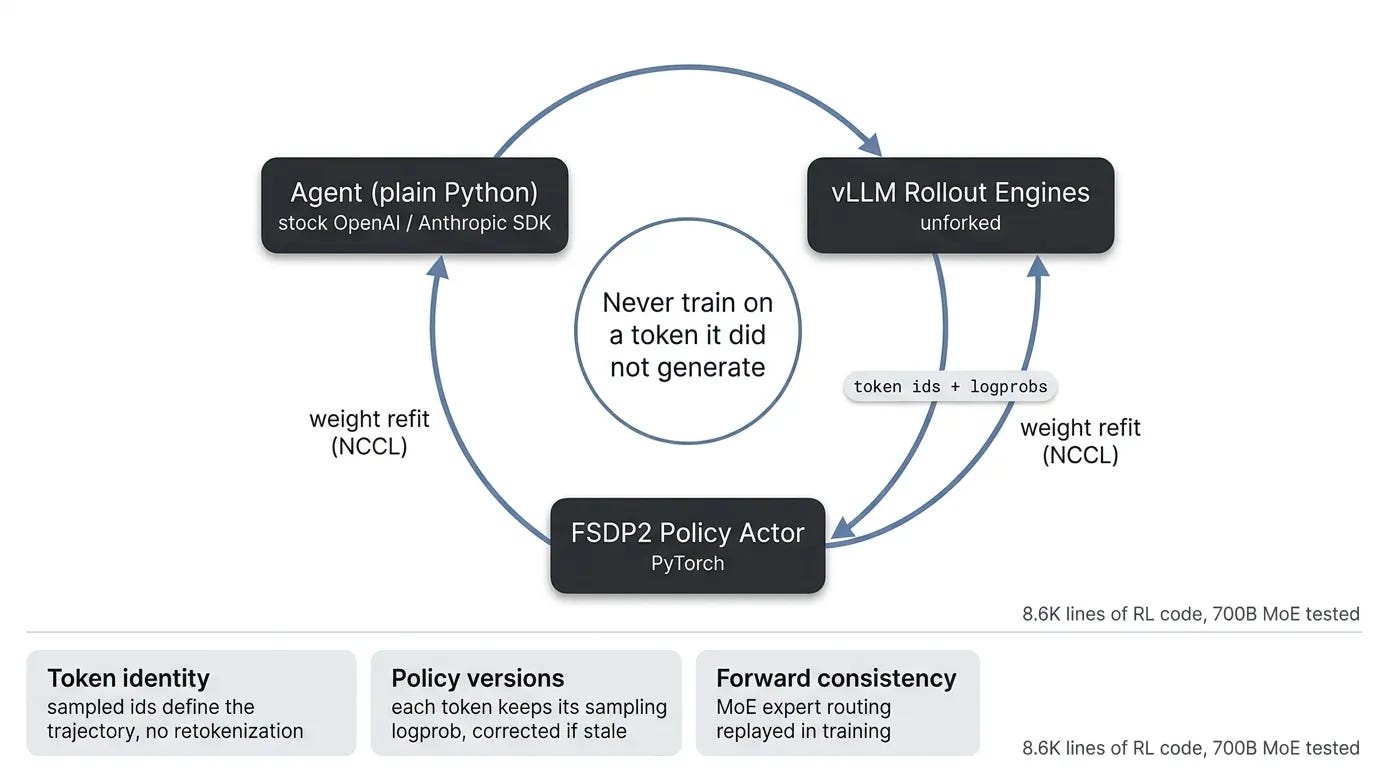
Five sentences to take with you
Molt is NVIDIA’s new open-source framework for training LLM agents with reinforcement learning, built as plain PyTorch around one asynchronous loop.
Its core guarantee: the trainer never sees a token the model didn’t generate, which kills a family of silent bugs that quietly corrupt agentic RL runs.
The whole RL path is about 8,600 lines of Python, against roughly 62,000 in verl, yet the same loop has trained a 700B mixture-of-experts policy.
Existing agents train as-is: point a stock OpenAI or Anthropic SDK at Molt’s loopback server and the harness becomes trainable with no integration code.
The price is deliberate narrowness, exactly one training backend and one serving engine, so teams outside vLLM plus FSDP2 should look elsewhere.
There’s a class of bug in agentic RL that never throws an error. Your rollout engine samples a token sequence, your trainer retokenizes the transcript, and the two disagree about where one token ends and the next begins. Nothing crashes. The run keeps going. The gradient is just quietly computed against tokens the model never actually produced, and three days later you’re staring at a reward curve that won’t climb, auditing your reward function, your prompts, your learning rate. Everything except the tokenizer.
Molt, released by NVIDIA on July 22 with an open-source repository, is a training framework organized around refusing that entire bug class. Its one-sentence contract: Molt never trains on a token it did not generate. The surprise is what enforcing that contract made possible. The complete RL path is roughly 8,600 lines of Python, several times smaller than the production stacks it matches in throughput, and the authors argue the size is the point, not a limitation.
The primer: why RL training runs two copies of your model
Every modern RL stack for LLMs splits the work between two systems. A serving engine (usually vLLM or SGLang) generates the rollouts, because inference engines are enormously faster at generation than training code. A distributed trainer (FSDP, DeepSpeed, or Megatron) computes gradients and updates weights. The two hold separate copies of the same policy, and after each update the trainer ships fresh weights back to the engine.
That split is where agentic RL gets treacherous. The two copies can disagree in ways that raise no exception. The engine and trainer can tokenize the same text differently. An asynchronous engine can keep generating with weights that are one or two versions stale, making your “on-policy” data quietly off-policy. And mixture-of-experts models add a third trap: the engine’s router and the trainer’s router can pick different experts for the same token, so the two sides evaluate different computation graphs while nominally running the same model.
None of these produce a stack trace. They produce a biased gradient, which looks exactly like a bad hypothesis.
Mainstream frameworks handle this with machinery. verl supports three serving engines and multiple training backends behind adapter layers and registries; that breadth is why its RL path runs to roughly 62K lines by Molt’s import-graph count, with slime around 25K and OpenRLHF at 7.2K. The layering is rational engineering for hyperscale production. But a researcher who wants to change an advantage estimator inherits all of it, and the change threads through trainer, backend, and rollout glue. The Molt authors, a NVIDIA team that includes OpenRLHF creator Jian Hu, call this a regime mismatch: hyperscale stacks optimize for the largest jobs, while research optimizes for the rate of algorithm change.
Code as user interface, with a second reader in mind
Molt’s first design principle sounds like style guidance until you notice who it names. The codebase must be readable by a human researcher in one pass, and navigable by an AI coding assistant, which the paper cites explicitly as a design audience: an assistant like Claude Code should be able to trace a feature from CLI flag to executed branch, tensor, metric, and test without reconstructing hidden control flow.
That’s a genuinely new design criterion for research infrastructure. The reasoning is practical. If assistants now share the work of modifying training code, then indirection doesn’t just slow humans down, it degrades the assistant’s ability to make correct edits. Molt treats code that needs a second pass as a defect even when it runs correctly.
The other principles follow from the first. Exactly one training backend (NVIDIA’s AutoModel with FSDP2) and one serving engine (vLLM), neither forked, because multi-backend abstraction is where layered indirection comes from. Performance parity with Megatron-based stacks as a hard constraint, not an aspiration. And modularity that follows the RL algorithm rather than the infrastructure: components map onto the agent, the rollout, the estimator, and the loss, so an algorithmic edit touches exactly one of them. A new advantage estimator in Molt is one pure function plus a flag, a metric, and a unit test. The paper calls it “an afternoon’s edit,” which is the entire pitch compressed into three words.
Three invariants instead of a reconciliation layer
Where other stacks reconcile engine and trainer after the fact, Molt structures the whole pipeline so divergence can’t enter. Three invariants carry the load.
Token identity. The sampled token ids define the trajectory, never a retokenized transcript. Prompts enter the engine as token ids, completions come back as token ids with per-token log-probabilities, and text never passes through a tokenizer mid-episode. Retokenization drift is eliminated by never leaving token space.
Policy-version semantics. Every action token keeps the log-probability it was sampled with. When a weight update lands mid-rollout, Molt pauses the engines, broadcasts the new shards over NCCL, and resumes the retained requests rather than discarding them. A resumed rollout mixes policy versions, so the loss applies a per-token importance correction with a sequence-level gate, and Molt refuses to run partial rollouts without that correction enabled. The framework won’t let you collect data it knows how to mishandle.
Forward consistency. Rollout and training must agree on model semantics, including MoE routing. Molt closes the router trap with rollout routing replay: the engine records which experts it chose per token, and the trainer replays those exact choices during the backward pass, so both sides evaluate the same sparse computation graph.
The most practically interesting consequence sits at the agent boundary. If your agent already runs against a stock OpenAI or Anthropic SDK, it trains as-is. Molt launches a loopback chat server in front of the engines; every request through it is captured server-side as token ids and log-probabilities, a pattern the paper calls token-in/token-out capture. No logprobs flags, no session plumbing, no framework-specific environment class. Your existing harness, browser agent, or eval scaffold becomes the training environment without modification. Even context compaction is handled: when a harness rewrites its prompt prefix to summarize old turns, the server detects the rewrite, seals the current token-exact segment, and opens a fresh one, so opaque compaction behavior stays trainable.
What staying small actually costs
The evaluation asks the only question that matters for a lean framework: does readability cost throughput?
The composed-not-forked design pays off first. Because Molt carries no vLLM patches, engine features arrive as configuration flags the day upstream ships them. On the shipped 35B multimodal MoE recipe (a 32K-context multi-turn tool-use task on 2 nodes, 8 training plus 8 rollout GPUs), enabling speculative decoding through the checkpoint’s MTP head cut per-step generation time from 329 seconds to 64, a 5x change from one flag. Optimizer CPU offload dropped actor peak memory from 64.7 GB to 46.4 GB, the difference between fitting and not fitting the training partition, at the cost of 18% slower training steps. Cached re-prefill of a growing conversation measured 0.05 seconds.
The head-to-head test puts Molt against slime, a Megatron-Core plus SGLang stack, on Qwen3-30B-A3B across two H100 nodes, both fully asynchronous, with every shareable setting pinned and the residual asymmetries disclosed. Under that matched protocol, throughput is statistically comparable. Leanness, on this evidence, costs nothing.
Scale is handled by configuration rather than migration. FSDP2 composes with tensor, expert, and context parallelism, and the same launch script that trains a dense 4B model expresses a DeepSeek-V3-class trillion-parameter layout as a flag change. That claim is exercised, not asserted: the team ran the full asynchronous loop end to end, rollout, weight refit, and optimizer step, on a 700B MoE at expert parallelism 256.
The misconception: small means toy
The reflex reading of “8.6K lines” is that Molt must be a teaching implementation that collapses the moment you make it big. The 700B run is the direct counterexample, and the mechanism behind it matters more than the number: Molt doesn’t reimplement scalability, it inherits it. Ray, vLLM, and FSDP2 are each hardened at frontier scale upstream. By composing them without forks and refusing multi-backend abstraction, Molt gets their scaling ceiling while owning only the RL logic between them. The bet is that the layering in mainstream stacks is a choice inherited from hyperscale, not the price of capability.
The honest caveats run the other direction. One backend and one engine means narrower deployment: no SGLang, no TensorRT-LLM, no DeepSpeed, no Megatron. Some combinations fail fast by design, packed batches under context parallelism among them. The line-count comparison measures implementation footprint, not usability, and the authors say so themselves. And the parity result covers one model family under one matched protocol; it’s a strong existence proof, not a benchmark sweep. Molt is also three weeks old. verl’s breadth exists because production teams kept needing things.
If you’re training agents, what to do with this
Molt slots in when you’re iterating on algorithms: new estimators, reward shaping, experience filtering, rollout schemes, on models from 4B dense to trillion-class MoE, and you live inside the PyTorch plus vLLM world. The repo ships Docker images, single-node and Slurm recipes, and estimators for REINFORCE++, GRPO, RLOO, Dr. GRPO, and GAE with a PPO critic selected by one flag, under Apache 2.0.
Skip it if your serving stack is SGLang-based, your organization requires Megatron, or you need reward-model training baked into the framework. And if you build on any stack, steal the auditing checklist Molt’s invariants imply. Ask three questions of your pipeline: do trainer tokens match sampled tokens exactly, do stored log-probabilities match the policy version that generated them, and do rollout and training agree on expert routing? Any “no” you can’t explain is a silent bias in your gradient.
The larger shift is in what “infrastructure quality” means. For two years the field has equated capable RL infrastructure with big, layered systems, and framework line counts kept growing. Molt is a serious, NVIDIA-backed claim that correctness comes from invariants, not from reconciliation machinery, and that the code a researcher and their AI assistant can actually read is the code that produces experiments you can trust. Whether or not Molt wins adoption, that standard, every trained token is exactly the token that was generated, is one you can hold your current stack to today.