
What is NVIDIA Openshell?

TL;DR
NVIDIA launched Agent Toolkit at GTC 2026: three open-source components (OpenShell runtime, AI-Q blueprints, Nemotron models) designed to make autonomous agents deployable and safe at enterprise scale.
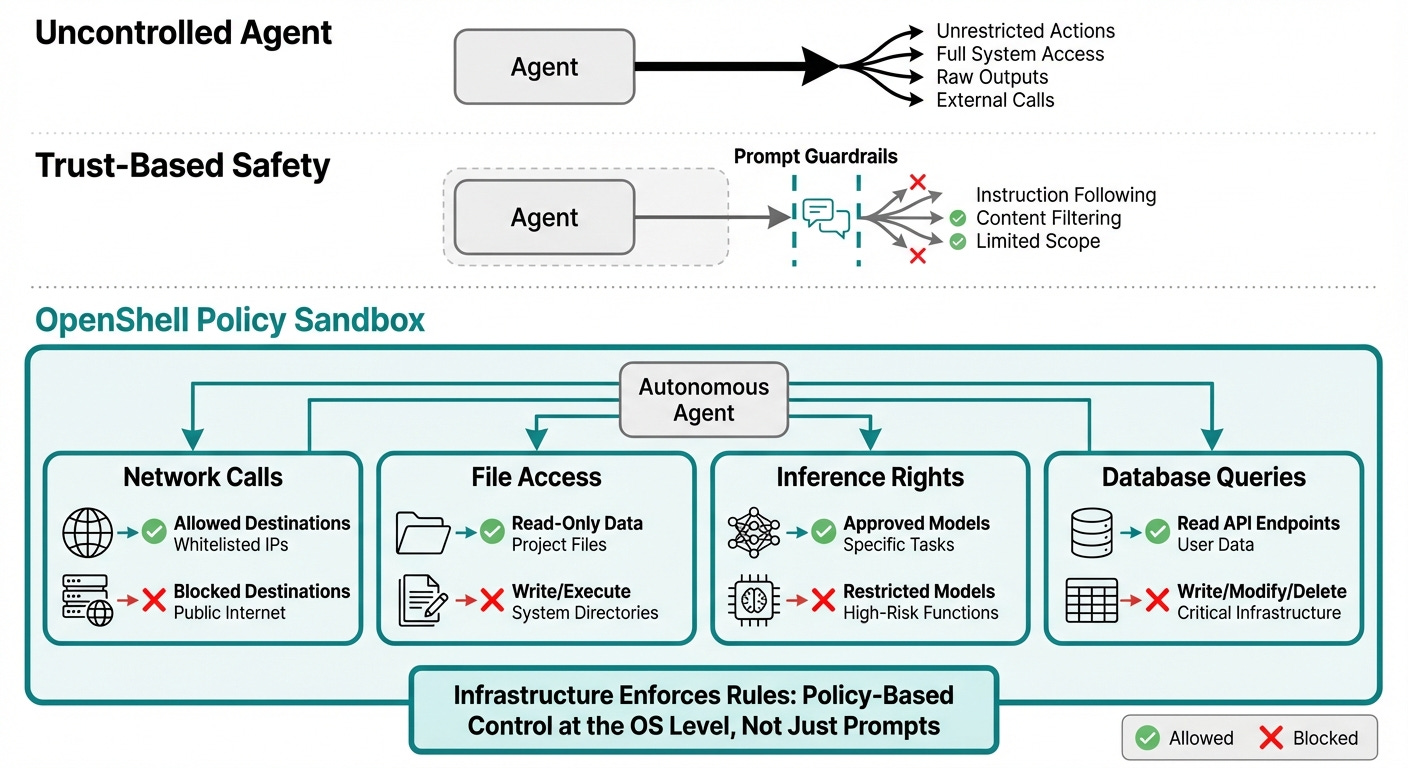
The key insight is policy-based sandboxing. Instead of hoping agents behave, OpenShell lets you define exactly what network calls, file access, and inferences an agent can make before it runs.
Enterprise adoption is already moving fast: 17 partners including Adobe, Salesforce, SAP, and Siemens are building with it. The toolkit is available now on build.nvidia.com across AWS, Google Cloud, Azure, and Oracle.
The future of work looks like this: an AI agent opens your email, understands your calendar conflicts, pulls data from three internal systems, runs a cost analysis, and schedules a meeting. Sounds powerful. Sounds terrifying.
Terrifying, that is, until you realize the agent can’t make a network call you didn’t explicitly allow. Can’t read a database. Can’t modify a file. Can’t do anything you didn’t tell it to do, because it’s running inside a sandbox with a policy attached to it.
That’s the bet NVIDIA just made.
Why Agents Need an Operating System
Here’s the problem with autonomous agents today: they’re powerful but opaque. You give a language model a set of tools (send email, query database, update calendar), and it decides what to do with them. The model might use them correctly 95% of the time. But what about that 5%?
In traditional software, you prevent bad outcomes through architecture. Your app can’t access databases it doesn’t have credentials for. Your server can’t reach networks that aren’t routed to it. The infrastructure itself enforces the rules.
Agents don’t work that way. You’re handing a model a toolkit and hoping it uses good judgment. You can add guardrails, write instructions in the system prompt, fine-tune for safety. But fundamentally, you’re trusting the model’s reasoning, not the architecture.
NVIDIA’s bet is simple: what if agents ran inside an operating system purpose-built for them? Not a prediction about what they’ll do, not a prompt telling them to behave well. An actual runtime that prevents certain actions from happening at all.
That’s OpenShell.
What OpenShell Actually Does
OpenShell is an open source runtime that sits between your agent and your infrastructure. It’s not a model. It’s not a guardrail. It’s plumbing.
Think of it like a Unix sandbox, but for agents. You declare a policy upfront: this agent can call these APIs, read these files, make these network requests. Everything else is blocked. The agent never even has the chance to try.
Here’s what that means in practice. An enterprise AI agent needs to pull customer data from Salesforce, analyze sentiment from a third-party service, and write a summary to a company wiki. That’s three separate integrations, three separate permission boundaries, three separate failure modes if the agent goes rogue.
With OpenShell, you don’t give the agent access to your entire Salesforce account. You give it an API key that can only call a specific endpoint. You don’t give it credentials for the sentiment service. You route its calls through an OpenShell policy that says “you can call this endpoint, with these parameters, once per request.” You don’t give it permission to modify the wiki. You give it append-only access to a specific page.
The agent still has agency. It can still reason about what to do. But the infrastructure limits its blast radius.
The Three Parts: Runtime, Blueprints, Models
NVIDIA’s announcement bundles three things together, and understanding why they’re bundled is more important than understanding what each does.
OpenShell is the runtime. It enforces policies. It runs locally on your infrastructure or on a cloud service, and it governs every network call, file access, and inference the agent makes.
NemoClaw is the reference implementation. It’s the early-preview package that installs OpenShell, includes open-source Nemotron models, and gives you a versioned blueprint for building a secure, sandboxed agent environment. If OpenShell is the engine, NemoClaw is the engine bolted into a chassis.
AI-Q is the agent blueprint. It’s a LangChain-based reference implementation for building deep research agents. It shows you how to structure an agent that can extract data from multiple sources, reason about it using both frontier and open models, and deliver answers. The benchmark that matters: AI-Q tops the DeepResearch Bench accuracy leaderboard while cutting query costs in half using a hybrid approach (frontier models for hard reasoning, open models for simpler tasks).
Nemotron models are the brains. Nemotron 3 Super is a 120-billion-parameter open model designed specifically for agentic reasoning. On PinchBench, it scored 85.6%, making it the top-performing open model in its class. You can run it locally inside OpenShell, or use frontier models in the cloud through a privacy router that controls what data leaves your infrastructure.
The design is modular on purpose. You don’t have to use all three. You can use OpenShell with your own agents. You can use AI-Q as a blueprint and plug in different models. You can run Nemotron standalone. But together, they form an end-to-end stack.
Why Enterprise Partners Are Already Adopting It
Seventeen partners are shipping with Agent Toolkit, and that number is not coincidental. These companies represent the entire stack of enterprise software: Adobe (content), Salesforce (CRM), SAP (ERP), Siemens (industrial), ServiceNow (IT operations), Cisco (networking), and others.
Why the fast adoption?
Because enterprises have a problem that NVIDIA just made solvable. For the past six months, every large company has been asking the same question: how do we deploy AI agents internally without losing control?
The agents are powerful. The risk is real. A single agent with overpermissioned access to your financial system could rebalance accounts, approve purchases, or transfer money. An agent with access to your source code could introduce vulnerabilities. An agent with access to customer data could leak it.
Current solutions are weak. You can write detailed instructions in the system prompt (”never approve purchases over 100k”). You can implement policy engines at the application layer (”block this request if it matches this pattern”). You can use separate environments and hope isolation works. But none of these prevent the problem at the infrastructure level.
OpenShell prevents the problem at the infrastructure level.
For the first time, an enterprise can say: “We’re deploying an autonomous agent to handle customer service inquiries. It can call these three APIs, and no others. It cannot access our internal database. It cannot send emails outside our organization. It cannot make external network requests except through this proxy.” And then you can actually trust the system, because the infrastructure enforces these rules.
That’s not incremental security. That’s a different category of deployment.
The Misconception About Agent Safety
Most discussions of agent safety focus on the model: Can we train it to follow instructions? Can we detect when it’s about to do something bad? Can we fine-tune it to be more honest?
These are valuable questions. But they’re asking the model to be trusted. OpenShell asks the infrastructure to be trusted instead.
The misconception is that agent safety is primarily a model problem. It’s also an infrastructure problem. And infrastructure problems have proven, scalable solutions. Unix permissions have worked for 50 years. Network segmentation has worked for 30 years. Process isolation has worked for 20 years. These aren’t new ideas. OpenShell just applies them to agents.
That doesn’t mean models don’t matter. It means models and infrastructure work together. A good model trained to follow instructions, running inside a well-configured OpenShell sandbox, is safer than either alone.
What Works Today, What Doesn’t
OpenShell and NemoClaw launched in early preview on March 16, 2026. What does that mean?
The runtime works. You can declare policies and they’re enforced. The infrastructure is solid. The open source reference implementations (NemoClaw, AI-Q) are production-ready and are already being integrated by partners.
What’s still evolving: the ecosystem of policies. Companies are still figuring out what a “good” policy looks like for different use cases. An agent handling customer service has different permission requirements than an agent managing supply chains. Shared best practices are still being developed.
The other thing that’s still early: the frontier models with OpenShell integration. You can run Nemotron models locally inside OpenShell. You can also route calls to frontier models (GPT-5, Claude, etc.) through a privacy router. But these integrations are happening at partner velocity, not platform velocity.
What definitely doesn’t work: using this as a replacement for good agent design. OpenShell enforces policies, but it doesn’t make a poorly-designed agent into a good one. An agent that loops infinitely on a simple task will still loop infinitely. An agent with ambiguous prompts will still produce ambiguous results. Infrastructure safety doesn’t fix reasoning.
When to Deploy Agents With OpenShell
If you’re building an internal AI agent (customer service, IT support, knowledge retrieval), deploy with OpenShell. The overhead is minimal, the safety benefit is real, and the operational burden of “prove we didn’t accidentally give agents overpermissioned access” is eliminated.
If you’re deploying agents across a large organization, OpenShell becomes mandatory. Not optional. The liability of an uncontrolled agent touching customer data or financial systems is too high. The compliance requirements (SOC 2, HIPAA, regional privacy laws) demand infrastructure-level enforcement.
If you’re building agents for external use cases (a bot for an API, an agent as a product), you still need OpenShell, but you need to think differently about policies. The agent might need more permissions than an internal tool. But you want those permissions to be narrow and auditable.
When not to use it: if you’re building a simple retrieval-augmented generation system (a chatbot that searches your docs and returns answers), you probably don’t need OpenShell. You don’t need infrastructure-level safety enforcement. Application-layer safety is sufficient.
The difference is agency. Simple RAG systems are essentially search engines with a better interface. They’re not making decisions. Agents make decisions. If something is deciding, you want infrastructure-level guardrails.
What This Means for the Agent Landscape
NVIDIA’s toolkit changes the economics of agent deployment. Before, you had to choose: either trust your model to behave well (risky), or build custom infrastructure to enforce safety (expensive).
Now you have a third option: use proven infrastructure patterns that have worked in other domains for decades.
This matters because it shifts agent adoption from “interesting technology we’re researching” to “deployable infrastructure we can actually use.”
The 17 enterprise partners aren’t adopting this for the hype. They’re adopting it because it solves a real problem in a way that works. Policy-based sandboxing is not novel. It’s been working in operating systems, containers, and service meshes for years. Applying it to agents is the natural next step.
What happens next is probably obvious: other platforms will add similar capabilities. Anthropic has MCP (Model Context Protocol) which is fundamentally about defining what a model can access. OpenAI will need something similar. The open source community will build alternatives. This isn’t a NVIDIA monopoly. It’s NVIDIA making a move that everyone will eventually make.
The real insight is that agent safety, at scale, requires infrastructure, not just training. And infrastructure is boring. But boring is good when boring means your agents can’t accidentally break your company.
References and Further Reading
NVIDIA Agent Toolkit Announcement - Official NVIDIA newsroom announcement of the complete toolkit
NVIDIA OpenShell Technical Blog - Deep dive into OpenShell policy enforcement
NemoClaw Documentation - Reference implementation guide
AI-Q Blueprint GitHub Repository - Open source implementation for enterprise search agents
AI-Q Architecture Deep Dive - Building deep research agents with LangChain
Nemotron Model Performance - Model specifications and benchmarks
What’s your experience deploying autonomous systems in production? Where do you draw the line between trusting the model to behave and enforcing infrastructure-level guardrails? Reply to this email or leave a comment.